
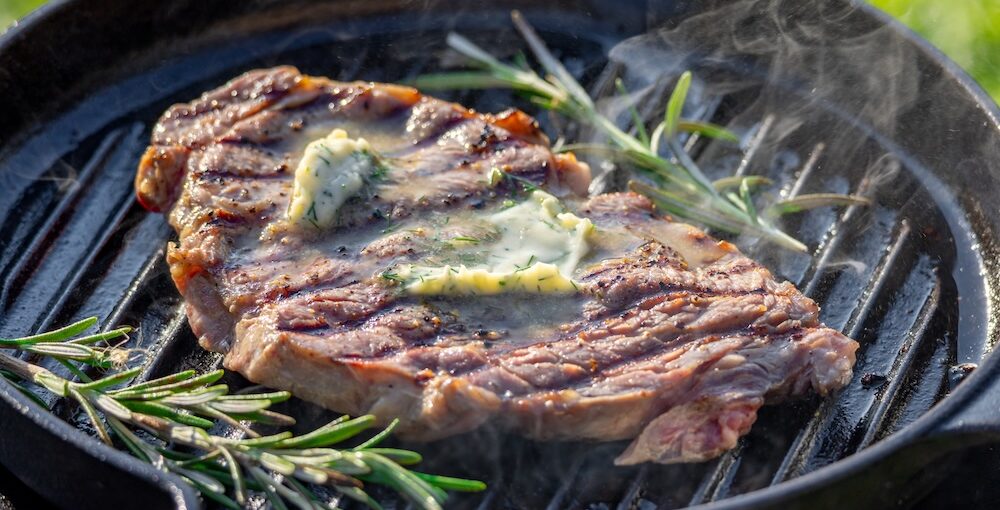
Farm-to-table grass fed steak requires different culinary techniques than grain-fed steak. These animals are active. They eat a natural forage diet. Therefore their muscle structure is more developed and their fat content is significantly lower.
This means if you cook a Blessings Ranch steak the same way you’d cook a commodity ribeye, you’ll likely end up with a “well-done” piece of leather. Here is how to master the nuances of grass-fed beef for a perfect result every time.
Why does grass-fed beef cook faster?
It’s a common surprise for new farm customers: grass-fed beef typically cooks about 30% faster than grain-fed beef.
Fat acts as an insulator.
In grain-fed beef, the heavy marbling (intramuscular fat) slows the conduction of heat through the meat. Grass-fed beef is much leaner, meaning the heat travels through the muscle fibers almost instantly.
If you are used to a 6-minute per side sear, then you’ll want to drop that to 3 or 4 minutes to avoid overshooting your target temperature.
How do seasons change the flavor?
One of the most beautiful things about buying from a local Tomball ranch is the beef reflects the “terroir” of the land. Because the cattle at Blessings Ranch eat what is growing, the flavor of your steak can subtly shift throughout the year.
During the spring, the pastures are lush and green. You get more herbal notes and a little extra beta-cerotene, which can give the fat a slight, yellowish tint.
In the winter, cattle transition to high-quality stored hay or dormant grasses, and you get a more mellow, concentrated flavor.
Does a reverse sear actually work?
For a thick-cut grass-fed steak, the reverse sear is the gold standard.
Start by placing your season steak in an oven set to 225℉. Let it reach an internal temperature of 115℉. Quickly sear it in a scorching hot cast-iron skillet with a bit of beef tallow or butter. Give it 60 seconds per side.
This prevents the “gray ring” of overcooked meat that can form around the edges of a steak while keeping the lean interior tender.
What is the carry-over cooking secret?
Because grass-fed beef is so lean and dense, it retains heat exceptionally well. This leads to significant carry-over cooking. Remove your steak from the heat when it is 10 degrees below your target temperature.
For example, if you want a perfect medium rare at 130℉, pull it off the pan at 120℉. During the rest, the temperature will climb to that perfect finish. If you wait until it’s 130℉ in the pan, it will coast into “Medium” or “Medium-Well” while it sits on your plate.
Why is the 10-minute rest non-negotiable?
We’ve all heard that we should let the meat rest, but for grass-fed beef, rest is a mechanical necessity. When meat is under high heat, the muscle fibers contract and squeeze the juices toward the center. If you cut it immediately, those juices pour out onto the cutting board.
A 10-minute rest allows those fibers to relax and reabsorb the moisture. For a lean grass-fed steak, that redistribution is the difference between a buttery, melt-in-your-mouth experience and a dry, disappointing one.
Get Grass Fed Beef Today
Ready to try your new steak techniques? If you live within 50 miles of our farm you can order steak online and expect delivery. Or just swing by Tomball and visit every Thursday through Saturday from 10-3! We’ll be happy to talk about our grass-fed beef and even introduce you to our cows. Looking forward to seeing you!